

Japan’s character economy is easy to misread from the outside.
The loud version is fandom: anime fans, game fans, idol fans, collectors, limited drops, collaboration cafes, long lines, resale prices, and foreign tourists buying character goods by the suitcase.
That version is real. But it is not the whole system.
The quieter version is more important.
A character appears in a convenience store, on a snack package, inside a card game, as a plush toy, on stationery, through a stamp rally, as a lottery prize, or as the small thing a child asks for during an ordinary family errand.
That is where the signal begins.
This issue is not about proving that Japanese people “love characters.” Many countries have fandoms. Many countries have major entertainment franchises. The question is different:
How does global character culture become local Japanese life?
My answer is simple. In Japan, characters do not only travel through media. They travel through retail, objects, family spending, parent permission, school-adjacent routines, and small everyday negotiations.
That makes the character economy more than fandom.
It makes it infrastructure.
The Signal
AOIFUTURE Dispatch is built on one working belief: the same internet-connected generation does not live the same future.
Children around the world may share YouTube, games, memes, characters, short-video grammar, and platform culture. But those inputs do not land in every country in the same way. They are translated by language, households, school routines, retail formats, parent anxieties, and local markets.
Japan’s character economy is one of the clearest examples of that translation.
A character may begin as animation, game IP, mascot design, or internet culture. In Japan it can quickly become something else: a card, a pencil case, a convenience-store campaign, a snack tie-in, a plush toy, a stamp-rally checkpoint, a prize good, a school-bag object, or a family purchase that does not feel like buying “media” at all.
That is the signal.
Character culture in Japan is not only a layer of fan enthusiasm on top of media. It is a family-mediated retail and everyday-life distribution system.
The Channel
Start with the channel, not the convention hall.
A convenience store is not a fan space. It is an errand space. People enter for lunch, coffee, a bill payment, a snack, a quick family stop, or something they forgot to buy on the way home.
That is what makes the channel powerful.
A specialist store asks the customer to choose a fan space. A convenience store folds character culture into ordinary movement.
Japan had 55,736 Japan Franchise Association member convenience stores in December 2024. Those stores recorded about 1.386541 billion customer visits that month, with average spending of 750.6 yen per visit, excluding tax.
Those are not child-specific numbers. They are not campaign-performance numbers. They are distribution-context numbers.
The point is simpler: convenience stores are dense, repeated, routine surfaces. If a character appears there, it does not need to wait for someone to announce fandom. It can meet people inside normal life.
The Evidence
The toy market shows why a simple demographic reading is not enough.
Japan has fewer children than it used to. That is true and serious. But if the conclusion is “therefore the child-facing character economy must simply shrink,” the numbers resist that story.
The Japan Toy Association reported that Japan’s domestic toy market reached 1.166422 trillion yen in FY2025, on a suggested-retail-price basis. That was 106.3% year over year and another record high. The major ten toy categories reached 796.729 billion yen.
Inside that market, card games and trading cards reached 338.414 billion yen, up 111.9% year over year. The association notes that this category is now about 30% of the whole toy market.
Plush toys reached 62.398 billion yen, up 138.2% year over year, with the association’s summary pointing to character plush demand including Myaku-Myaku, Super Mario, Kirby, and Pokemon.
The formal character toy category was 68.130 billion yen, down 10.9% year over year.
That decline is not a problem for the argument. It is a useful warning label.
“Character toys” as one toy-market category is not the same as the whole character economy. Character demand also appears through cards, plush toys, variety goods, convenience-store campaigns, food collaborations, prizes, stationery, and adult collector behavior.
Some of the market is children. Some is parents. Some is adults. Some is tourists. Some is resale and collecting. Some is gift-giving.
The point is not that every category grows.
The point is that character culture moves through many surfaces at once.
The Campaign Mechanics
Public campaign pages show the mechanics.
In June 2026, I photographed one of those mechanics at a convenience store in Japan. A display for Ginga Tokkyū Milky☆Subway offered a die-cut sticker with the purchase of two eligible Meiji products; customers could choose from five designs.
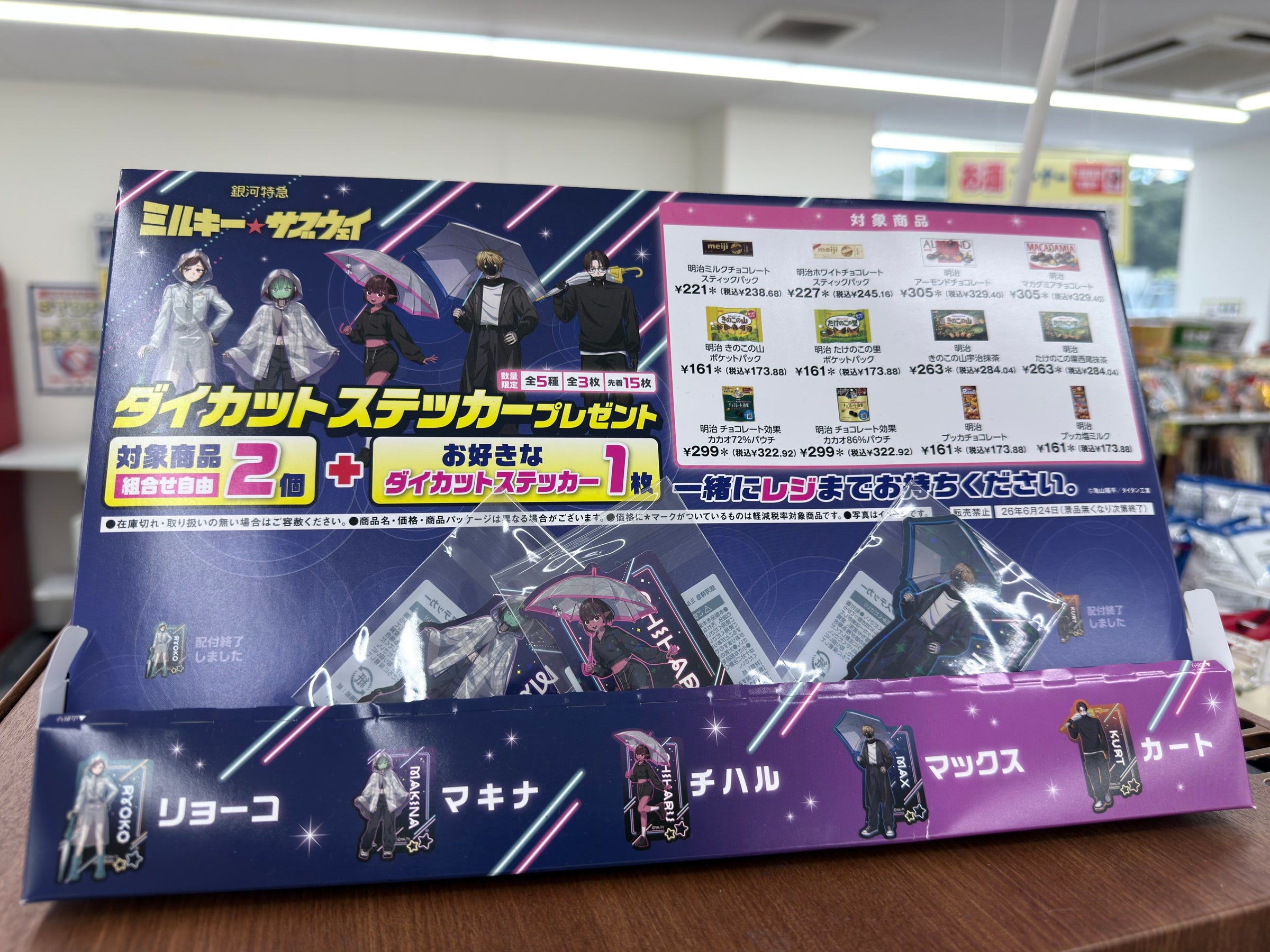
A Ginga Tokkyū Milky☆Subway promotion observed at a Japanese convenience store in June 2026. Customers could choose one of five die-cut stickers after buying two eligible Meiji products. Photo by the author.
What caught my attention was where the offer sat. No specialist-store visit was required: a character item had been attached to two eligible products in an ordinary convenience-store channel.
The photograph records one campaign at one store at one point in time. It shows the in-store offer and its purchase mechanic. It does not establish national reach, campaign performance, market size, or the behavior of children, parents, or customers more broadly.
Seven-Eleven Japan’s official pages include a character-goods surface and a ONE PIECE WT100 LINE stamp-rally campaign. Those examples do not prove national child behavior. They are not market-size evidence. They are not evidence that every customer is a fan.
They are mechanics evidence.
They show how a character can turn a store into a checkpoint, a campaign into a small ritual, and an errand channel into a cultural interface.
That is the useful reading.
Fandom asks, “Who is intensely attached?”
Infrastructure asks, “Where can this appear before attachment has to be declared?”
The Parent Layer
The missing actor in many character-economy stories is the parent.
Children may ask. Parents often pay. Parents also permit, limit, redirect, co-shop, postpone, negotiate, or quietly normalize the object.
That is why the character economy is not only a fan system. It is a household system.
A card pack is not just a card pack. It can be a reward after homework, a birthday request, a conflict about trading, a thing a child wants to bring to school, a reason to visit a store, or a purchase a parent allows because it is small enough to say yes to.
A plush toy is not just a plush toy. It can be comfort, identity, collection, tourism, gift, room decoration, or a family memory.
A convenience-store campaign is not just a promotion. It can become a parent-child errand: can we stop there, only one, not today, after practice, if you finish homework, is this worth it?
This is the household origin of market behavior.
AOIFUTURE Dispatch should watch that layer carefully. Not by exposing private family life. Not by turning children into content. But by treating small parent questions as signals:
Why is this character suddenly everywhere?
Is this play, waste, learning, identity, or social life?
Why does this object matter so much?
What am I actually buying when I buy this?
What should I allow?
Those are not soft questions. They are where future consumer behavior begins.
The Gen Alpha Layer
For Gen Alpha, a character is rarely only a title.
It may be a video, a game, a friend reference, a card, a plush toy, a line at school, a search query, a YouTube thumbnail, a snack package, or a small object carried in a bag.
Trading cards make this especially visible.
The FY2025 market scale is large: 338.414 billion yen for card games and trading cards. But the more interesting part is what cards do socially.
A card is media, object, game system, scarcity signal, collecting habit, and social protocol. It creates comparison, play, exchange, storage, conflict, status, rules, and adult supervision. A video can be watched alone. A card asks to be brought somewhere.
Once it is brought somewhere, a wider system appears: sleeves, deck boxes, store events, school rules, after-school rules, parent rules, trading norms, anti-theft norms, release calendars, resale prices, and adult judgment.
This is why “what do kids watch?” is too narrow.
The better question is what travels after watching.
Does it become an object? A phrase? A request? A game? A school conversation? A family negotiation? A small purchase? A future memory?
That is the Gen Alpha signal.
The Translation
This is where Japan becomes useful as a field site.
The inputs are globalizing: major IP, platform culture, YouTube grammar, games, characters, cards, memes, and branded worlds. But the translation is local.
In Japan, that translation often passes through dense retail and object systems. Convenience stores, toy aisles, stationery shelves, gacha, campaign goods, food tie-ins, school-adjacent objects, and family errands all become surfaces where character culture can land.
This is not “Japan is unique” as a vague claim.
It is a more specific observation: Japan has unusually routine surfaces for turning media attention into small everyday objects and family-mediated purchases.
That is why the word infrastructure helps.
Fandom describes intensity.
Infrastructure describes availability.
The character economy has both. But availability explains why characters keep reappearing even for people who do not think of themselves as fans.
They are distributed, repeated, miniaturized, priced, bundled, scanned, collected, and placed in the path of routine behavior.
Why It Matters
For IP owners, this suggests that character strategy is not only about content reach or fan conversion. It is about surfaces: where a character can appear without demanding too much attention.
For retailers, it shows why campaigns are not just promotions. They can make the store into a cultural interface.
For educators and parents, it explains why character goods can feel bigger than their price. A small object may carry social meaning, identity, memory, and negotiation.
For people outside Japan, it offers a way to read Japanese pop culture before it becomes export spectacle. Watch the ordinary surfaces first: the convenience-store shelf, the card aisle, the school-bag object, the parent saying yes or no.
That is where culture is being translated.
What Should Travel
Japan’s character economy is not a fandom layer on top of media.
It is a family-mediated retail and everyday-life distribution system.
The stronger question is not “which character is popular?”
The stronger question is:
How many surfaces can a character occupy before anyone has to call themselves a fan?
Next Watch
The next useful evidence will not come only from another market-size number.
It will come from small observations:
Which characters are visible in convenience stores this month?
Which goods are priced low enough for a parent to say yes casually?
Which campaigns require app, QR, LINE, or account participation?
Which objects are meant for children, and which are really for adult collectors?
Which characters move between screen, card, snack, plush, stationery, and school talk?
Which parent questions repeat across households?
AOIFUTURE Dispatch believes accumulation is intelligence.
One shelf photo does not prove a system. One parent question does not prove a generation. One campaign page does not prove a market.
But accumulated carefully, they become a map.
That is the work.
Data Says
Japan’s domestic toy market reached 1.166422 trillion yen in FY2025, 106.3% year over year, on a suggested-retail-price basis.
Major ten toy categories reached 796.729 billion yen in FY2025.
Card games and trading cards reached 338.414 billion yen, 111.9% year over year, and about 30% of the whole toy market.
The character toy category was 68.130 billion yen, 89.1% year over year. This is one toy category, not total character-business market size.
Plush toys reached 62.398 billion yen, 138.2% year over year, with character plush cited in the association’s summary.
Japan Franchise Association member convenience stores counted 55,736 stores in December 2024.
Those stores recorded about 1.386541 billion customer visits that month, with average spending of 750.6 yen per visit, excluding tax.
Seven-Eleven official pages show character/IP campaign mechanics such as character goods pages and LINE stamp-rally campaigns.
Sources
Japan Toy Association, Toy Market Data / FY2025 market materials: https://www.toys.or.jp/toukei_siryou_data.html
Japan Toy Association, FY2025 domestic toy market PDF: https://www.toys.or.jp/pdf/2026/2025_data_zenpan.pdf
Japan Toy Association, FY2025 major 10 toy categories PDF: https://www.toys.or.jp/pdf/2026/2025_data_10bunya.pdf
Japan Franchise Association, Convenience Store Statistics archive: https://www.jfa-fc.or.jp/particle/70.html
Seven-Eleven Japan, campaign pages: https://www.sej.co.jp/cmp/
Seven-Eleven Japan, character goods page: https://www.sej.co.jp/products/toy.html
Seven-Eleven Japan, ONE PIECE WT100 LINE stamp rally campaign: https://www.sej.co.jp/cmp/opstamp2605.html